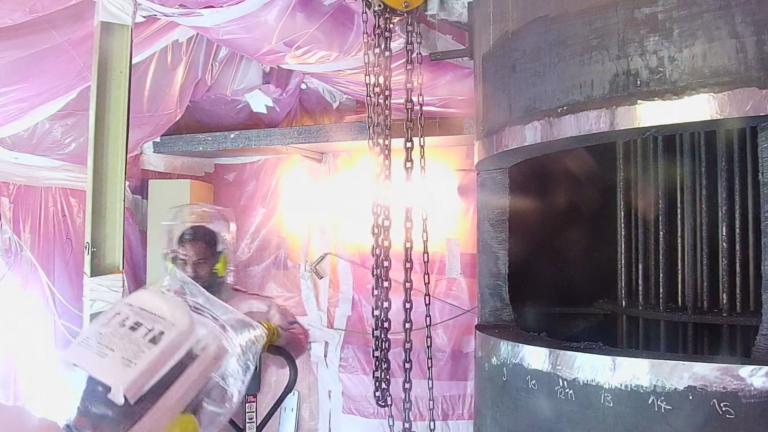
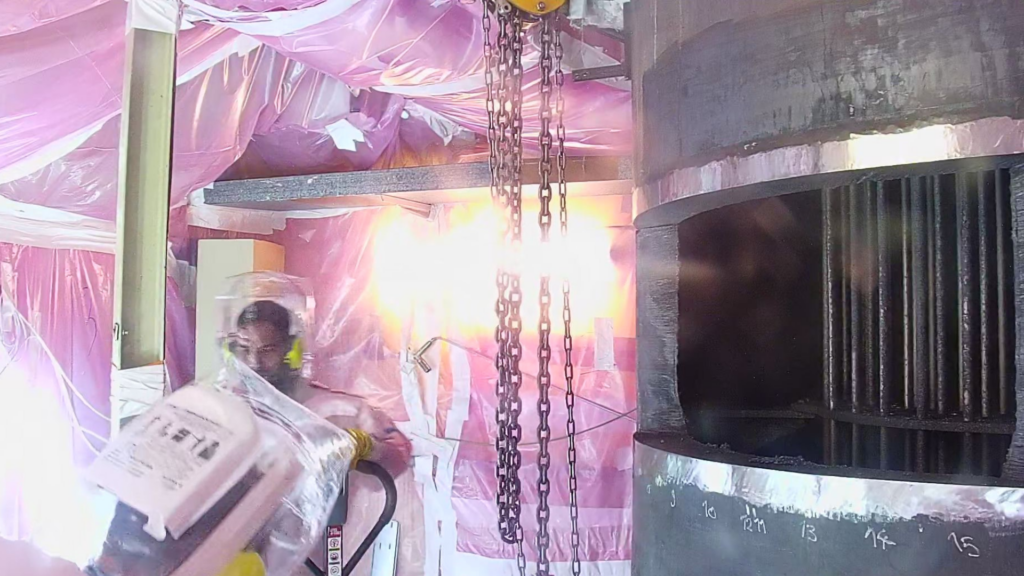
The sample, consisting of steel and stainless steel, was impressively large: 660 kg; 1.20 meters by 60 centimeters; and more than 200 mm thick. Its analysis should provide EDF with new data on the aging of the materials that make up the pressurizer. This data will inform the work being conducted as part of the DDF program, particularly to study the operating life of nuclear reactors beyond 60 years.
Before carrying out work at the Fessenheim site, the teams at Onet Technologies spent nearly eighteen months preparing for and validating this unprecedented operation. The challenge was to replicate, during testing, conditions that were sufficiently representative of the upcoming operation to demonstrate that on-site sampling could be carried out safely.
This qualification phase covered all the operations required to extract the sample, including laser cutting of the ferrule. In particular, the teams developed specific processes, operating procedures, and tooling tailored to the environment and constraints of the planned operation at Fessenheim. The qualified operations included:
- the collection and extraction of the sample in a particularly confined space;
- the design of a tool that allows the sample to be handled and extracted safely;
- the design of a transport container intended to transport the sample while protecting it from external hazards and ensuring radiation protection;
- the drilling and plugging operations on the pressurizer and the PEL (Pressurizer Expansion Line) required to prepare for the intervention;
- pressurizer sealing operations, including the fabrication and qualification of welded assemblies;
- laser cutting of the equipment.
The tests were conducted at Onet Technologies’ Laser Technocenter in Chusclan, where the teams were able to test various methods and replicate as closely as possible the conditions of an operation in which every step had to be perfectly mastered before deployment at the Fessenheim site. The level of realism achieved during this qualification was also highlighted by our client, EDF.
At the end of this preparation phase, the teams had a validated procedure and a set of resources specifically designed to make the transition from testing to a full-scale operation.
A laser-cut part designed by Onet Technologies to meet the requirements of the pressurizer
Cutting the ferrule was the most critical step in the sampling process. For this operation, Onet Technologies implemented a laser process developed specifically for use with this type of equipment.
The solution used combines a high-power laser source, an L.Dcom nuclear-powered laser head, and a remotely operated robotic arm. It made it possible to cut through more than 200 mm of steel and stainless steel to cut the ferrule, while keeping workers at a safe distance from the work area. Completed in just a few hours, the cut freed up the sample for EDF’s analysis.
By successfully carrying out this operation, Onet Technologies reaffirms the expertise it has built up over more than a decade in the field of laser technology applied to the nuclear industry and demonstrates the feasibility of deploying a complete L. Dcom laser system even for one-time operations.
This project expands the range of possible laser applications in the nuclear industry and opens up new possibilities for future projects. It also provides the teams with valuable experience in using this technology for cutting operations on very thick equipment. A first for France’s nuclear fleet!
A collective effort commensurate with the challenge at hand
On site, the sampling process was not limited to cutting open the pressurizer’s jacket. The Onet Technologies teams first removed and then reinstalled the pressurizer’s manhole cover. They also designed, manufactured, and installed a specialized ventilation system to establish a unidirectional airflow between the sampling chamber and the pressurizer. The purpose of this system was to control contamination in the work area and filter the fumes generated during the operation. Once separated from the pressurizer, the sample was extracted, decontaminated, and packaged for transport. The teams also managed the waste generated during the operation.
The entire project was completed without any accidents related to lifting operations or the use of the laser. No technical issues arose that would have jeopardized the process, which had been validated during the preparation phase.
An operation of this kind could not rely on a single area of expertise. The sampling process drew on a variety of disciplines and areas of expertise at Onet Technologies, from the preparation and qualification of the equipment to its deployment in the field. About fifteen employees participated in the design and qualification of the equipment, after which the teams on site took over to prepare for and carry out this unprecedented operation. Engineers, laser specialists, decommissioning and waste management teams, as well as support and logistics staff, worked together throughout the project.
Thanks to their expertise, our teams were able to provide solutions tailored to EDF’s needs and ensure that operations ran smoothly.
This operation also made it possible to continue developing laser applications in the nuclear industry. The process has been in use since 2015 for other sampling operations requiring remote cutting of very thick materials, such as at the CEA center in Marcoule.
This project has now become a benchmark for Onet Technologies. The lessons learned from this unprecedented qualification and project will enable the teams to build on this experience to meet similar future needs, both in France and internationally.
This project owes a great deal to the preparation work, but also to the collaborative efforts of the teams working alongside EDF: UTO, DP2D, the Fessenheim site, AMT, and UNIE.
A huge congratulations to our teams for their work on this major project, and thank you to EDF for the trust they have placed in Onet Technologies!