



Reception: A Key Entry Point in Corporate Hospitality Management
In an era of hybrid work and the war for talent, the corporate headquarters can no longer be merely a place people pass through; it must become a destination. For large organizations, the challenge is to reduce the “brand dissonance” between innovative communication and a physical experience that is sometimes fragmented.
This is wherecorporate hospitality management comes into play. This systemic approach transforms customer service into a powerful signal of appreciation, drawing inspiration from the standards of the luxury hotel industry. By focusing on reciprocity in customer care, the company no longer limits itself to managing customer flow; instead, it nurtures its service culture and transforms hospitality into a true driver of intangible performance.
Key takeaways:
- A holistic approach: Hospitality management goes beyond physical reception to facilitate seamless interaction between people, spaces, and services.
- A strategic foundation: As the first link in the value chain, customer service ensures consistency between your brand promise and the actual experience
- From a support function to a point of differentiation: Operational customer service is giving way to a shift toward higher-level service approaches, which have become a key differentiator for large organizations.
- A return on attractiveness: This strategy tangibly strengthens the employer brand and fosters loyalty among talent and partners.
- A cultural shift: Transforming customer service is not merely a technical adjustment, but a comprehensive effort centered on a culture of service excellence.
Transformed Work Environments: New Challenges in Corporate Hospitality Management
Large organizations have undergone a profound transformation of their real estate portfolios. The monolithic corporate headquarters has given way to complex ecosystems: multi-use campuses, regional hubs, and widespread flexible office spaces. However, this architectural transformation will only realize its full potential if it is accompanied by a revolution in service. In a hybrid work environment, the office is no longer a necessity. It is a destination.

This new reality calls for a higher level of hospitality. If an employee chooses to leave the comfort of their home to come to the office, their expectations regarding services and efficiency are significantly higher. The reception area thus becomes the primary indicator ofa site’s appeal: it must offer a seamless experience that compensates for the inconvenience of commuting.
In addition, the nature of the visitors themselves has changed. The reception area no longer handles a uniform flow of visitors, but rather an unprecedented mix of uses:
- The remote worker who needs to be directed to a locker or a quiet area.
- A partner or freelancer who must be able to integrate seamlessly into the company’s ecosystem.
- International delegations whose cultural norms require a high degree of customization.
- For the candidate, the onboarding process is the first “moment of truth” regarding the employer’s promise.
Given this complexity, functional reception serves as an initial operational solution, but it must now be part of a more comprehensive approach to the user experience. Workplace management teams must therefore coordinate diverse workflows to ensure a consistent visitor and work experience.
Hospitality management: a comprehensive framework, not just another layer of service
Corporate hospitality management should not be confused with a simple upgrade of concierge services. It is a systemic approach that breaks down the traditional logic of operational “silos.” Whereas a traditional organization strictly separated security, reception, and space management, hospitality management acts as a strategic link.
It is no longer about managing tasks, but about guiding a journey. This vision draws directly from the standards of the luxury hotel industry, particularly through the role of the concierge or butler. The latter does not merely fulfill a request; they anticipate needs, resolve issues before they are even noticed, and ensure a seamless experience across every area of the building.
To structure this approach, hospitality management relies on three inseparable pillars:

our vision
“We’re seeing growing expectations from companies: they no longer want to simply welcome visitors; they want to create an experience. This means moving away from a task-based approach and toward a journey-based one. The welcome experience is at the heart of this transformation, because that’s where it all begins. When it’s well thought out, it’s almost invisible, yet it shapes the entire perception of the site and the company.”
The customer experience:it all starts with the welcome
Frédéric PAILLEY, CEO of Onet Reception
The reception area: the operational hub of the customer journey
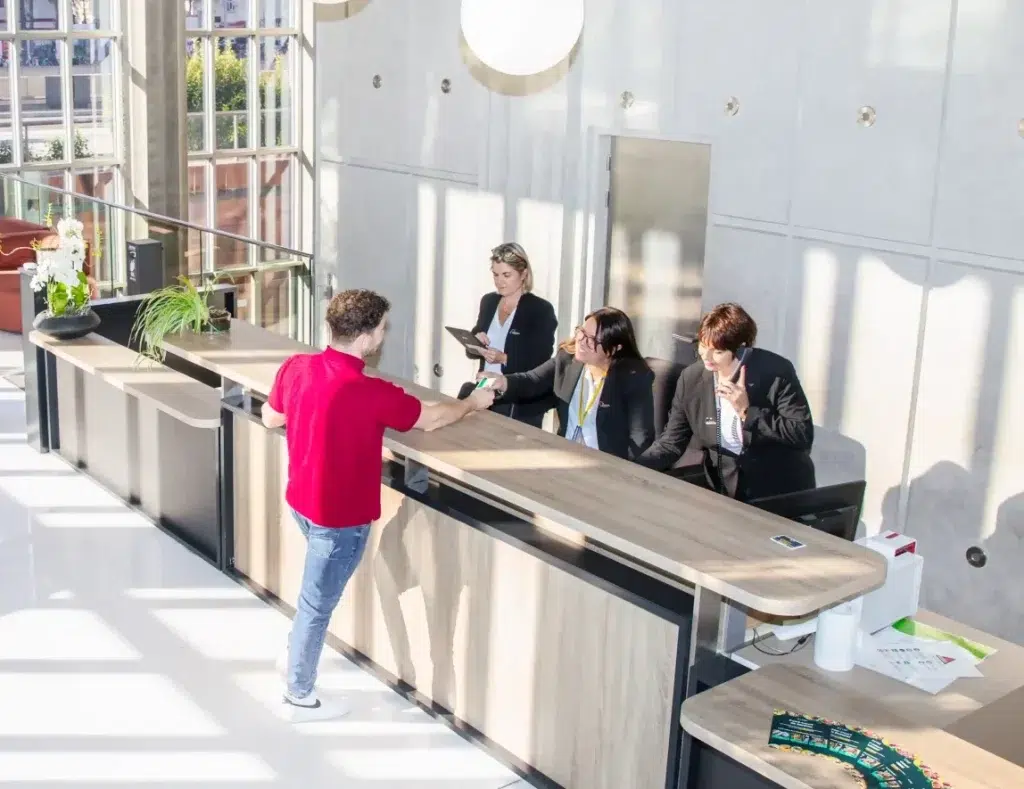
While hospitality management permeates every aspect of a building’s life, the reception area remains its cornerstone. This is where visitors form their first impression. In a successful hospitality strategy, the reception area does more than simply welcome guests: it sets the tone, fosters a sense of trust, and makes every person who walks through the door feel valued.
For large corporations, viewing customer service as a strategic function means shifting from a focus on managing customer flow to a focus on designing customer journeys. This requires a detailed understanding of the diversity of these journeys:
- For strategic clients: The reception experience should reflect the company’s commitment to excellence, with personalized service that keeps wait times to an absolute minimum.
- For the employee on the move: They should act as a logistics facilitator, ensuring a smooth transition from their current location to their future workplace.
- For service providers: Customer service is key to ensuring safety and operational efficiency, without compromising on courtesy.
An effective front desk staff knows what’s happening on the third floor, anticipates elevator congestion, and monitors the availability of dining areas. It is this thoughtful awareness that transforms a simple service into a true hospitality experience. In short, the front desk ensures consistency between the brand promise and the guest’s actual experience.

Why are some organizations rethinking their approach to customer service?
A classic, structured, and professionalperfectly meets the needs of many small and medium-sized businesses. But for certain corporate headquarters, campuses, or environments where image is critical, expectations change dramatically. What was once a satisfactory standard may now create a gap between the brand promise and the actual experience.
When a fragmented customer journey creates friction right from the start—a VIP visitor who’s been misdirected, an overly rigid security procedure—it’s that promise that suffers. For these organizations, the problem isn’t the reception process itself, but a strictly operational mindset that focuses on tasks rather than meaningful moments.
There are three key strategies for those who want to turn customer service into a true strategic asset:
A broader "journey" perspective
Whereas traditional reception services attend to visitors at the front desk, hospitality management focuses on what happens before (pre-registration, arrival notifications) and after (escorting guests to their seats, departure from the venue). It is this continuity that creates a memorable experience.
A service culture in action
Beyond procedures, it’s the attitude that makes the difference. Training in the principles of premium hospitality allows you to turn every interaction into a moment of genuine care that fosters emotional connection.
Agility in the Face of the Unexpected
Complex service environments require the ability to adapt in real time. Modern hospitality does not rely on rigid scripts, but on teams capable of tailoring their response to the actual needs of each guest.
For organizations that reach this milestone, customer service ceases to be a cost center and becomes a driver of brand image, attractiveness, and customer engagement.
Expert insight: steering the transformation and ensuring consistency over the long term
The transition from traditional reception services to ahospitality management strategy cannot be improvised. It requires a level of service engineering that few large organizations can handle on their own in-house. This is precisely the approach we take at Onet Reception designing and implementing customized hospitality journeys, crafted to reflect each organization’s identity and transform every touchpoint into a consistent and memorable experience.
The contribution of a specialized partner operates on three fundamental levels:
Level 1 Course design and traffic flow analysis
The expert doesn’t just “assign” staff. He begins with a sociological and technical analysis of on-site usage patterns. Who are your visitors? What are the bottlenecks during peak hours? By combining traffic flow analysis with service design, he develops visitor reception protocols that eliminate irritants and streamline access to spaces.
Level 2 The embodiment of a service culture
The difference between decent service and a memorable experience lies in the approach. A premium hospitality expert recruits and trains their teams in the specific principles of hospitality: handling the unexpected, emotional intelligence, discretion, and proactivity. This service culture ensures that every host or hostess becomes a true ambassador for your corporate culture.
Level 3 Data-Driven Performance Management
Modern hospitality management is data-driven. Using advanced reporting tools, experts can measure the quality of the experience in real time (wait times, visitor satisfaction, space occupancy rates). This approach enables continuous improvement and agile resource allocation based on actual changes in the building’s needs.
In this model, the service provider acts as a hospitality coordinator. They ensure coordination among all stakeholders in the building so that the guest experience is just as seamless on the ground floor as it is on the top floor.
Our vision is as follows:
Transform every touchpoint into a vivid expression of the organization’s identity, by positioning customer service not as an operational constraint, but as the driving force behind a high-value-added branding strategy.
Toward a New Era of Corporate Hospitality
The transformation of work styles presents a unique opportunity for large companies to reaffirm their distinctiveness. By placing hospitality management at the heart of their real estate and HR strategies, they are not merely modernizing their offices: they are creating spaces for living and gathering where consideration is the norm.
Since customer service is the first and last point of contact, it bears the responsibility for this success. Making it a strategic lever means choosing excellence in customer relations as the driver of performance.
Are you looking to streamline your hospitality management process?
Are you looking to streamline your hospitality management process? At Onet Reception, we support you every step of the way: assessment, process design, team training, and performance management. Together, let’s make your guest experience a true reflection of your brand’s appeal and identity.
Ces contenus peuvent vous intéresser



Do you have a need or a question?
Our Onet Reception experts Onet Reception available to answer all your requests for information or quotes.