


How can we meet the challenge of reducing water consumption in the cleaning of food processing sites?
Reducing water consumption is a major concern in the cleaning of food production units. That's why we need to be able to respond to the constraints of our customers, who are regularly faced with injunctions to reduce their water consumption. We use innovative solutions to respond to these demands, while maintaining optimum sanitary safety.
A fully mastered process
Onet's expertise lies in Food Processing. This sensitive sector generally requires daily cleaning in 5 phases: pre-washing, detergency, rinsing, disinfection, rinsing.
To reduce water consumption, we recommend 3-phase cleaning whenever possible. This solution enables us to retain the essential steps: pre-washing, cleaning and disinfection carried out in the same phase, and final rinsing. This eliminates the need for an application phase and an intermediate rinsing phase.
Upstream, we offer a tailor-made response to all our customers. Philippe Cuenot, Onet's National Food Hygiene Expert, and Nicolas Bargibant, Onet's Regional Food Hygiene Expert, describe our process in detail:
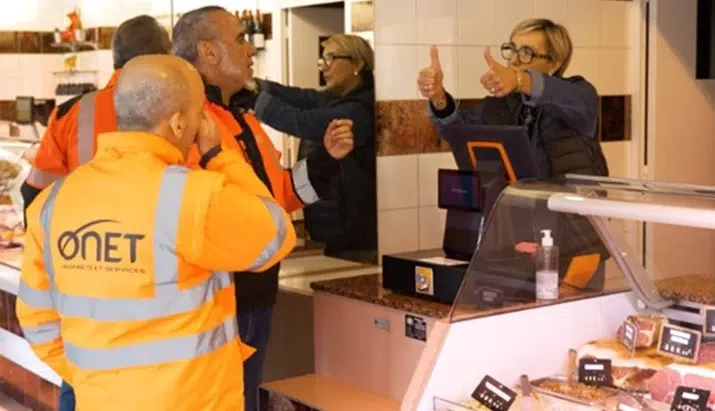
In order to build a customized offer for each of our customers, we systematically carry out a site visit and inventory. Ideally, we arrive at the end of production, so that we can see the site in real conditions, as it will be when we arrive. It's also an opportunity to make the customer aware of good waste management practices, which in turn will help him save money.
Onet's range of solutions
We offer our customers in the food industry a range of dedicated solutions. These include :
Steam
Steam cleaning is preferred in sectors where cleaning with water is not appropriate: bakery, pastry, cookie and viennoiserie.
In this sector, we can install automated systems on conveyor belts, consisting of cleaning ramps that project steam to loosen dirt and a suction ramp to remove loosened dirt.
Ozone gas disinfection
The advantages of ozone disinfection are manifold: it uses no water, leaves no residue and requires no rinsing. Unlike conventional methods, ozone avoids the use of traditional chemistry. Its diffusion capacity is superior to that of other disinfectants, making it even more effective. However, its use requires certain precautions. Ozone must be used away from human presence and in the absence of any organic matter.
Ultrasound
Ultrasonic cleaning is particularly suitable for cleaning parts and small equipment by soaking. Two approaches are available: on the one hand, a fixed bath where utensils, plastic baskets or other equipment can be immersed and then removed once cleaning is complete. On the other hand, the system can be used in-line, in particular for the hook chains found in slaughterhouses. These hooks, of which there are many, are difficult to clean. By immersing them in an ultrasonic tank, they can be cleaned continuously during production, without interrupting the line. The major advantages of this method are the absence of chemicals, low water consumption and improved hygiene for these particularly difficult-to-clean items.
Other solutions exist to reduce water consumption, such as the use of lactic acid for disinfection, disinfectants authorized without rinsing, or even cryogenicswhich enables dry cleaning of certain equipment. Finally, for our customers who would like to opt for more efficient, environmentally-friendly equipment, we offer a turnkey solution for investment in agri-food cleaning equipment.
Ces contenus peuvent vous intéresser

Do you have a need or a question?
Our experts Onet Cleaning and Associated Services are at your disposal to answer all your requests for information or quotes.