Onet Technologies' 3D and mechanical teams develop a digital twin to investigate a tank at CEA Marcoule
CEA's UP1 plant in Marcoule is home to the 71-21D vessel, which is particularly irradiating (250 Gy/h). To support sampling and investigations in this tank, Onet Technologies teams have developed a digital twin to simulate the configuration of the booms that will be lowered into it, developed by our partner CLEO. Explanations with Quentin Schneider, deputy manager of the mechanical department, Florent Serre, mechanical and ECC (electrical control and command) manager, and Jules Zimmerman, apprentice mechatronics engineer, our Onet Technologies employees who worked on this mechatronics project.
Investigating tank 71-21D: an unprecedented radioactive challenge for our teams
The aim of the overall service provided by Onet Technologies is to carry out investigations and studies for the dismantling of tank 71-21D at CEA Marcoule's UP1 facility. These investigations are part of the acquisition of basic data for decontamination/dismantling operations and the recovery of deposits in tank 71-21D.
This vessel is particularly irradiating (250 Gy/h), even more so than the elephant's foot at Chernobyl, so Onet Technologies is faced with a very risky project at the Marcoule site. To intervene in the tank, our partner CLEO has developed a remote-controlled arm capable of descending into this extremely hostile environment. But to guarantee the precision and safety of interventions in the face of this unprecedented radioactive challenge, Onet Technologies' teams have also designed a digital twin* to display the booms in the tank in real time.
Operation of the digital twin developed by Onet Technologies to investigate tank 71-21D
The digital twin created by the Onet Technologies teams for the 71-21D tank investigations interfaces with the investigation booms developed by our partner CLEO, which will be lowered into the tank to take samples. It enables the pilot to appreciate the actual position of the boom in a 3D environment.
In fact, only one camera can be present in the tank. However, the pilot needs two cameras to be able to appreciate distances, in the same way as the eyes do with their binocular vision. This is precisely the point of the digital twin, which is there to compensate for this absence of binocular vision , and which consists in projecting the investigation poles into a 3D scene. The operator can then move in any direction within this 3D scene.
To debug this system, the Onet Technologies teams simulated the operation of the booms on a physical engine from the CEA. To ensure that it was working properly, they then connected the digital twin to this physical engine, in the same data transfer configuration as the real thing, prior to the start of the actual worksite.
When moving on to the actual tank, an investigation and reconstruction of the tank will have to be carried out, as the construction drawings may vary from the actual tank configuration.
The advantages of the digital twin for 71-21D tank investigations
The strengths of this solution developed by Onet Technologies are numerous:
- Risk reduction: simulating operations on the digital twin minimizes the risk of accidents involving the release of radioactive material present inside the 71-21D vessel, and ensures operator safety.
- Improved precision: 3D visualization of investigation poles ensures greater precision in intervention.
- Save time and cut costs: the system reduces intervention times and optimizes human and financial resources.
- An adaptable, upgradeable system: the system designed by Onet Technologies is not set in stone. It is modular and will eventually be adaptable to other remote-controlled arms and highly complex handling machines. What's more, the system's architecture means it can be upgraded to incorporate new functions.
- Better understanding of the working environment : by connecting the digital twin to the simulator developed by CEA, the team was able to validate the virtual system before deploying it on site.
The reliability of these tools provides operators with a control experience identical to the one they will have on site, thus avoiding the risk of human error and enabling the solution to be debugged.
With the CEA's physical engine and Onet Technologies' digital twin providing real-life conditions to those operators will experience on site, their training and practice is carried out months in advance! This guarantees that they will be properly prepared, well in advance of the start of the actual project, scheduled for autumn 2024.
A tool developed entirely in-house at Onet Technologies
Three Onet Technologies employees worked on this digital twin project, from the 3D cell and mechanical department teams. The low-cost solution was developed entirely in-house and implemented in just 200 working hours!
The digital twin developed as part of the investigations on vessel 71-21D is a promising technology, and testifies to the expertise of our teams in the design of innovative technological tools.
Drawing on its engineering skills and capacity for innovation, Onet Technologies has established itself as a trusted partner for high-risk nuclear decommissioning projects requiring innovative, high-performance solutions.
Bravo to our teams for this ingenious solution, and thank you to the CEA for its confidence in this ambitious project!
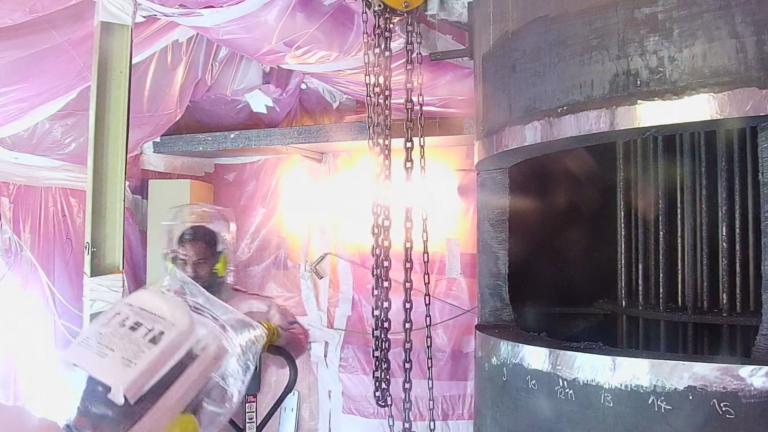
Full-scale testing of the digital twin at CEA Marcoule.
* What is a digital twin?
A digital twin is a precise virtual replica of its physical twin. This replica is continuously enriched and updated with data collected in real time on its physical twin. In our case, the term "digital twin" is not accurate. The information is sent unilaterally, so it's more like a digital shadow. The data from the various sensors means that the poles are synchronized with our model. For the sake of simplicity and understanding, the term "digital twin" has been retained for this project.
The concept of the digital twin is often used in industry, engineering and product design. In the nuclear industry, a digital twin of a machine can be created to monitor its condition, predict potential failures, optimize performance and simulate different operating scenarios.
Digital twins can also be used in other fields such as healthcare, smart cities, agriculture and more. They enable better understanding, analysis and management of real-world systems, facilitating informed decision-making and optimization of operations.
Ces contenus peuvent vous intéresser
Do you have a need or a question?
Our Onet Technologies experts are at your disposal to answer all your requests for information or quotes.